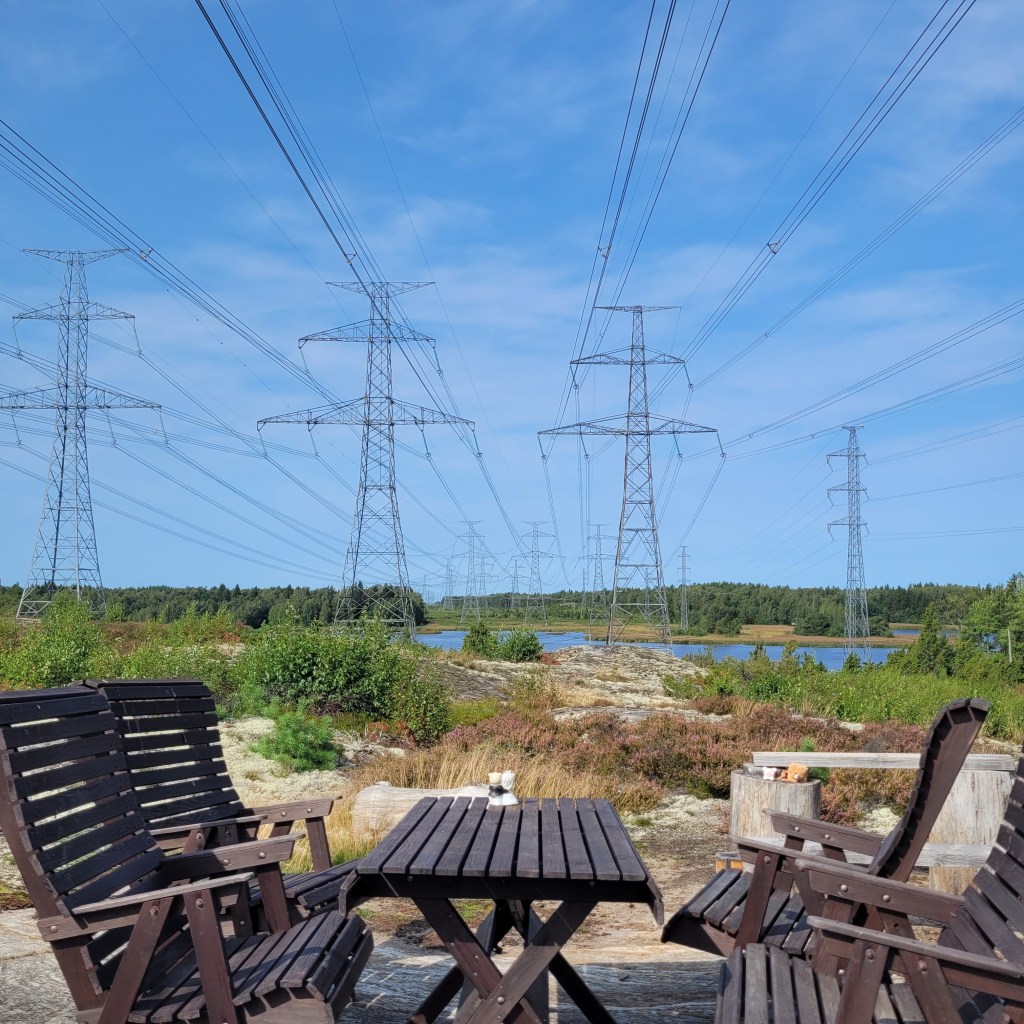
One third of Finlands electricity supply passes in the grid above. Below runs a nature trail that partly goes through a summer cottage area. Across the water is Olkiluoto Island.
Text by Axel Sievers, some reflections on fieldwork in Olkiluoto-Eurajoki, Finland this August.
“God gives and god takes”. The employee at Eurajoki municipality laughs. The real estate tax on nuclear energy industry injects roughly 20 million euros into the municipality each year, although after national equalization tax and a state aid tax, the municipality is left with roughly 10 million. The tax level is 3.1% of the estimated exchange value of the nuclear property, and decreases along with the depreciation of the assets Olkiluoto one, two and three.
Onkalo, on the other hand, poses a political economic conundrum. Its use value is to fixate spent nuclear fuel in the bedrock, effectively producing a fragmented landscape, split in two. One lived energy landscape above, and one dead storage landscape below. The plan is to produce a facility that functions autonomously for 100 000 years after humans have sealed and forgotten the storage. Since the use value covers a vast future, how does one tax the sealed repository – which is currently categorized as a type of nuclear industry. At the moment, Onkalo is under construction, and the property tax it generates increases as the facility is constructed. When sealed in 2120, does the value of the asset depreciate? And what does the depreciation of the exchange value tell us of its use value? At Eurajoki municipality, no clear answer could be given. But the interviewee generously entertained my question by posing that as long as it is still functional, it should be taxed, right?
The energy landscape of Eurajoki municipality is partly reflected in the internal nature of its lived environment. With 9,000 inhabitants, the municipality far surpasses the economic means of most other municipalities its size. A new sports center, a new supermarket, a brand-new library and one of the lowest income taxes in Finland, the landscape of Eurajoki is suffused with tax generated on the capital circulating through water, steam, uranium-nuclei and energy grids. In a far future, will Eurajoki be able to metamorphose from energy landscape to waste landscape in a manner that provides sufficient funds for the maintenance of its lived landscape?

The new library in Eurajoki town.
 Nuclear Natures
Leave a comment